Friday, November 28, 2025

Thanksgiving day on the Green Lady (Corfu)

Thanksgiving day arrived on Corfu cold and rainy so our touring was limited although we ended the day on  high note. (By the way, we shouldn’t complain about the weather. It’s been absolutely beautiful up until today) The island played critical roles in the defense of what became Europe.  It started around 700bce by the Eritreans and subsequently by the Phoenicians, and as commerce grew they apparently pissed off the folks at Corinth and thus one of the first recorded sea battles occurred. Here’s a link for a condensed history https://www.greeka.com/ionian/corfu/history/ but let it be said they were involved with Athens,  Rome, Byzantium, Venice, France and the British before they were unified with Greece in 1864.  It shows up in the art, the architecture, the food …..


Yes, we prepared our Thanksgiving meal with three others cruise clients supervised by two chefs ( and maybe a couple mimosas. 


And we ended up with:


seafood chowder, followed by a fillet mignon with leek soufflé and finished up with a Bailey’s chocolate mousse.   


Oh yes, we had worked up an appetite 


And then an example of East meets West in this Basillica. 


Check out this ceiling. Very unusual for a Greek Orthodox Basilica 


Off to Croatia. 


Thursday, November 27, 2025

Soda Bay ( Crete )

Today we visited Crete. The island was settled during the Bronze Age bce 3000-1000.  Some call it point zero of western Civilization. In fact Europe was named for the Cretian woman   featured in Zeus’s Abduction of Europa. Oh, Zeus was hidden from his father here as well because Zeus’s father killed the 3 previous babies of his mom.  Oh and Zeus’s nurse maid was a long horned mountain goat called Cornucop.  And when the horn got broken  the horn continued to feed the baby. Thus the cornucopia and your Thanksgiving  tie in.   


https://share.google/images/z6OTAcGWsgsGT71Yj


 You are welcome. 


So leaving the ship we see an amazing port. Lot of people settled here - Minoans, Phoenicians. Greeks, Romans, Ottomans, Venetians ( not necessarily in that order). The harbor where we docked was constructed by the Venetians - the lighthouse is on a Venetian base with an Ottoman addition of a Minarette style tower. 


The port and its buildings were subsequently redone by each subsequent society. 

Before the port there was a wall. Here is part of the wall from the Minoan period which separated the town from the shire. The current city actually had to buy some properties from residents so they could expose more of this 3000 year old wall.


Door from the Venetian period.  We saw how the art morphed depending on who was in power. 

The well dressed Cretian was always armed. 


Materials from old Greek temples were used in building walls- note the cylinders : parts of Greek columns.


And in the center of the old city was the fountain. Fed by a dug aqueduct which ran under the street bringing fresh water from the hills. 


This would have been the home of a well healed shopkeeper with the store on the street and the residence upstairs. Now repurposed for tourists. 


Going back to the Bronze Age (3300-1200 BCE0 of the Minoans they had devised a system of banking - banking goods rather than currency.  Below are some Bronze Age remains of the “banks’.  To validate ownership they used seals: could be rings, amulets etc to verify identity by pressing the seal into wax document. 


Below is believed to be the building (remains of) depicted in the seal above.  The man pictured was the ‘owner’ of the identity.  This one is quite integrate.  They could also be just a design. 


And to prevent the entire area from having no modern commercial purpose structures are often built over the sites. 


The Ventians had huge buildings on the water to do ship repair:

“The need for the Venetian fleet to maintain a constant presence on Crete led Venice to build new shipsheds arsenall), where ships could be repaired and their equipment maintained. In their initial for the shipsheds opened onto the sea which washed intd them so that ships could be hauled up. Most of them had vaulted roofs and were interlinked via arched openings in their side walls. The 17-shed complex was built from 1526 to 1599 and had two main entrances. Under Ottoman rule they were converted into military warehouses. Over time, nine of the seventeen shipsheds in the complex were demolished Today, one group of seven contiguous vaults are preserved, plus one more to the west: the Grand Arsenal, which houses the Centre for Mediterranean Architecture.”


These arches were originally open air so they could drag the ships in. When the Ottomans arrived, they converted them to warehouses.


And then we found the synagogue which is still active. 


A small local community of 30 Jews maintain the shul and volunteer as guides. There is evidence of Jewish presence from 2300 years ago. This building appears to be from the 1600s . A British rabbi comes in for the holidays but otherwise they self manage. They have what I think was said to be the only active Mikva  in Greece.  Recently they celebrated a Bar Mitzvah and last week a wedding. There are a total of about 130 Jews on the island.


This is the Mikva (ritual bath). There has been no rain as of late so water is low and it slated for cleaning when the rain comes.  

The shul also had its own ETROG TREE. 


And then, of course, we always like to check out the local stores. In contrast to Swedens wall of tonic waters, the grocery store here has quite a display of local honeys.


And of course there is always fish:

Oh, and ….


And so we sailed off into west. 


11/26 update at Kalamata

After a rough night at sea we arrived in Kalamata. We were to visit the palace of Nestor, a well preserved ruin. We chose to skip it, sleep late, have a nice breakfast, walk around town and then relax. Good choices.


Now we are leaving for  Corfu the Northern most of the Greek Isles.


Monday, November 24, 2025

Mainland separated from Peloponnesus

Today David took a trip to Corinth.  Heard of Corinthians?  Yup that Corinth.  The bus left early  Monday morning and we drove through the Port of Piraeus (the port area for Athens) which is an experience in itself. 
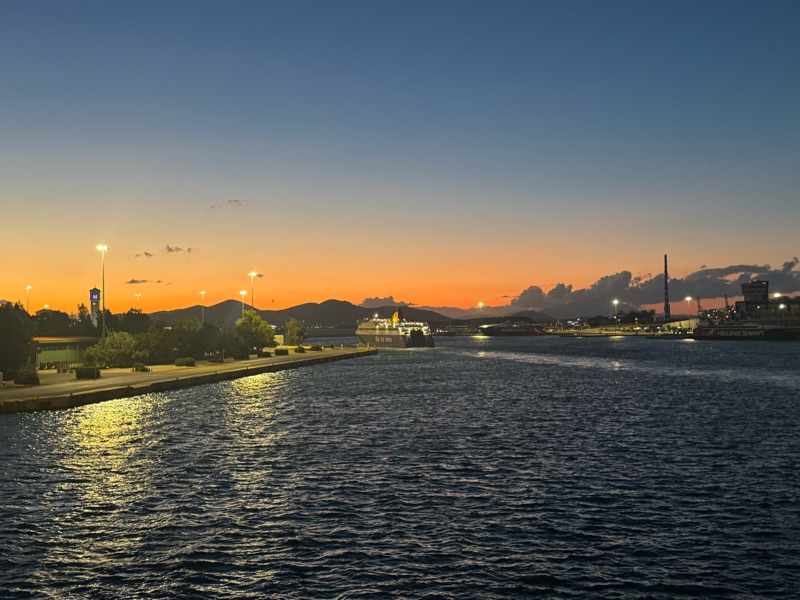

 Speaking of Pireas, when cities like Athens and Rome were first started ships were not really part of life and the cities were not built on the coasts.  The boats used  were rowed (6 oar early galleons) and travelled only along the shores.  (Reference Greco Persian wars. 460bce)


Pireas however became more important as “navigation” came to the Mediterranean and was an early example a city planning: an example of the hipodean system ie streets we’re in a vertical and horizontal block system.  The port is huge- the 4 or 5th largest in Europe. 


It was an 1 1/2 hr trip to from the ship in Pireas (port of Athens)  along the harbor ports  along the shipyards and shipwrites, the warehouses and petroleum tanks and past major natural gas hub before getting into more rural areas.


It is said often here that your geography is your destiny and because of the hilly terrain and a lack of flat lands it becomes obvious how the whole system of city states built up.  Land holdings were small. Even now a large portion of the population in the south will have enough land for a few olive trees. Our guide, with his mother and aunt has 32 olive  trees which they harvest themselves and which provides enough oil for 18 months. Typically the city states would have a center less than 3 hours by Oxcart from the individual farms.


So there is this isthmus that is called, surprisingly the Isthmus of Corinth - a narrow strip of land that connects the Peloponnese peninsula to mainland Greece. 


ATHENS IS A BIT NORTH AND Sparta a bit south.  Certainly a defendable land defense. But as commerce widened there was the issue that to sail from one side is Greece to the other required a 15 day journey. What if they could cut a canal?  For centuries this was a dream but rock like granite can be an issue.  Nero started a canal in 63 ce. It was finished 1900 years later in 1863. https://www.britannica.com/place/Isthmus-of-Corinth
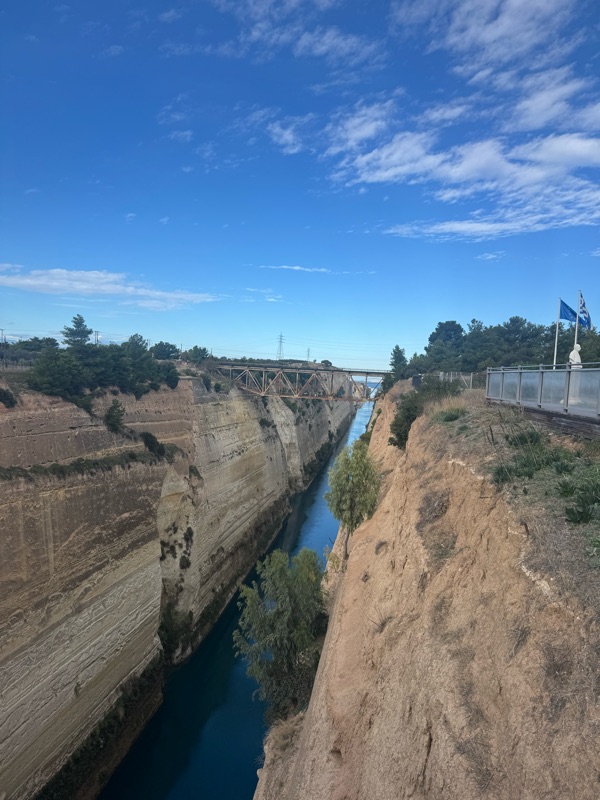


So now instead of 15 days it takes 15 minutes to go about 4 miles.  Of course now the ships are much bigger but the canal does still get used some. 

And then what do I see….
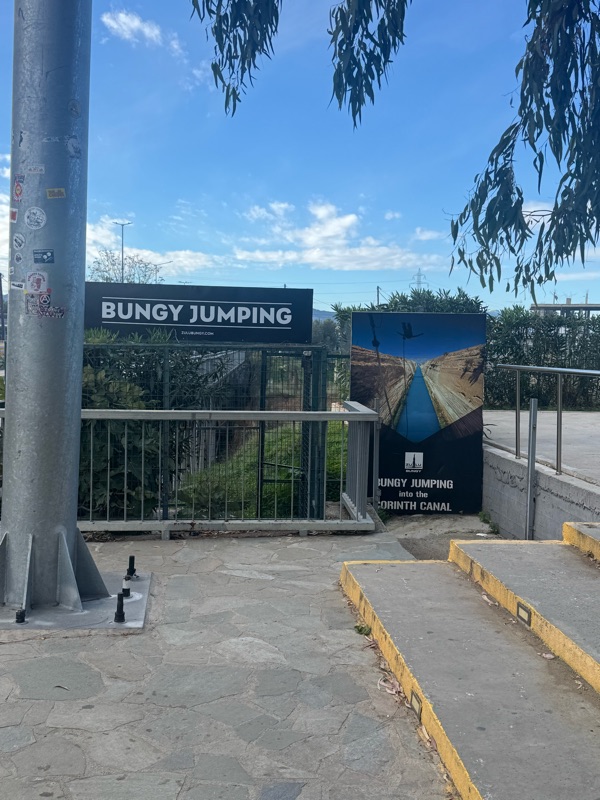
Hmm, what’y’think? Think I could do it in 15 minutes?
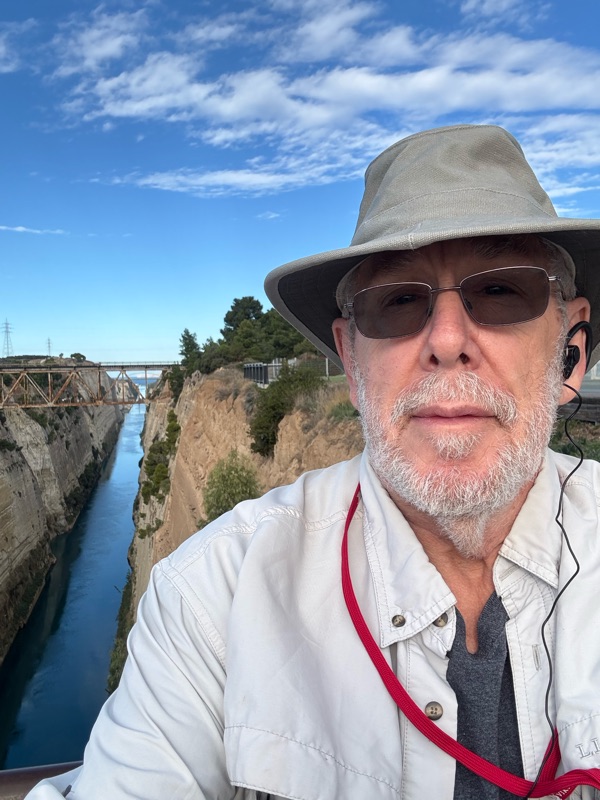
Well we had to get back on the bus.  


We’re off now to ancient Corinth and the Temple of Apollo 

see the bleachers?  


Temple of Apollo god of light, balance (karma)  and music. Most worship took place outside the temple. Processions and animal sacrifice were the normal thing. Gods needed blood as life was seen as a give and take with the gods.  Their concept of sin was a bit different. One was supposed to preserve what one might call Karma. If you didn’t it annoyed the gods and    when karma was disrupted you needed a sacrifice (birth, death, stealing and other events) 


Built 530 BCE  built of soapstone in  Doric style these columns are still standing.  


 in the above shop the Forum (agora) is  in the foreground. On the far side of the forum at about 11:00 o’clock you’ll see a raised platform with people standing on it. This is where Paul did his preaching to the Corinthians.   


And that platform was called a Veema (rhymes with Bema. A coincidence? I think not )  in later days a chapel was built over the bema and you see some relics of the Middle Ages added as well. 

Paul stayed here 18 months peaching and working as a tent maker.  


We wondered about all the fire extinguishers under the pine trees. Apparently these trees are a real nightmare as if they catch fire the pine cones flare up and catch everything around on fire as well. 


Some of the first recorded synagogues (from the time of the Jewish Temple) were found in Greece. In Delos from 60 bce and these relics from a synagogue in Corinth from about 50 bce. Note the candelabra, the Lulav and the etrog. 


And of course there were the self aggrandizing statues of the big wigs. 

One of my favorite stories of the day was that when Nero was touring here he was in a chariot race. Apparently he fell out of the chariot but was still awarded the prize for winning. The tour guide goes: much like what’s happening on the other side of the Atlantic now. 


I leave you with the statue of what is presumed to be Dianna. Note the high boots and belts - suggestion of a hunter 


Meanwhile, my own hunter was out on her own quest. Melanie went on a food tour instead of going to Corinth and was very happy. 😃 


The end.