Saturday, December 6, 2025

Siracusa


12/5/25. Awoke to the last “Supermoon” of 2025 over Syracuse Sicily this morning 

And looking to the north through the mist you can make out (what I think is) Mt Etnna. 


And at 8:30 off we go to the 11th century BCE Greek settlement of the small island of Syracuse called Ortigia .  
 Apparently when they showed up they saw quail here this the name. There is also a bunch of mythological stuff tied in which you can look up if you like as at this point my mind is fried.  


And of course much was made of the name Siracusa which 
Is commonly thought to refer to the fact that this is a place of abundant fresh water. Water comes from the mountains, filtered through the rock and then appears in spring throughout the area. 

We stoped first at the Temple of Athena which over the years became Roman, Catholic, Muslim …..  Like many of these archeological finds this area was covered with apartment house before someone recognized a column in a wall and started to dig  


While there is water, there is no soil so if you want plants you have to grow them in pots which line the streets. Cars mostly miss them.  


And of course we visited a number of Churches 


And fountains (this one is not ancient) 

Oh, and then another Church. 


This one is the Dome of Syracuse. Originally identified as another temple To Athena  from 5th century bce because of the Doric columns.  Then the Roman’s dedicated to Minerva then Constantine made it a church for Christians. This was the capital of Sicily until the 9th century. Then this building became a mosque. Apparently it’s only the columns that survived the 17th century earthquake. 


Check out the various columns


The tile floors were varied and quite splendid


Check out the light reflection from the stained glass. 


This was the home of Archemedies but that would require another book. 


Remember I mentioned the abundance of fresh water? 
The first picture is of a spring in the foreground  (famous as the meeting place of two love struck gods) In the background is the salt water of the Ionian Sea. 


Now  back to the Jewish street. 


It’s estimated there may have been up to 3500 Jews 1/5 of the population at its height. There was an active congregation here until 1492. Sicily was part of Spain, and subject to the inquisition. .

. Interesting story about how in 1989 a woman who bought a hotel wanted to do some extension and discovered Europe’s oldest Mikvah some 38 feet below the hotel.  58 steps hewn through rock. At the time of the inquisition the community filled it in and buried the entrance to prevent it being found. It stayed hidden for centuries. 


And, if you bring your own chaperone you can still make arrangements to use the mikvah. 

And some other random shots:


I think the HickeysMusic building would look great with a few arms sticking out to support plants 


Friday, December 5, 2025

Zadar and the Sea Organ

 No, not that type of organ- a pipe organ played by the sea.


But we’ll get to that. 

Zadar, another city which we never heard of, is known in Croatia as the place having the best work life balance.  Of course this tour guide was from Zadar.


He also mentioned that it’s the only place on the East Coast of the Adriatic where a city is flat. There’s about 30 to 40 miles of flatland to the north south and east and at the far end of the east side, there is a range of high mountains. This keeps the cold winter winds and the accompanying snow from coming to the coast. Now there’s a tunnel that goes through the mountain so if you want to ski you drive 40 miles go through the tunnel and you’re in winter.


The beach was considered the soul of the city. Having been called the Montecarlo of the Adriatic the city was very popular but repeatedly destroyed. The last time 16 of the 18 building in the area were destroyed.  The community decided to take advantage of the natural beauty of the place and rebuild it as a park: after all, Alfred Hitchcock claim this spot had the most beautiful sunset in the world, better than those of Key West. 

Of course this shot is of Sunrise as we missed sunset.  


Now these are not just steps going into the sea. The genius of this idea was to bury organ pipes up to 16 feet long under the steps and as the waves played upon the steps these various pipes would be triggered.  Thus the “Sea Organ”. 

Take a listen: 


And next to these steps are  9 solar panels built into the plaza: replicating the 9 planets. These each  absorb sunlight all day and at night become a colorful display. And this display is controlled by the music generated by the Sea Organ.  Unfortunately we were too high up on the ship for you to be able to hear it  with the display. (And the sea was pretty calm so no huge color spikes. 


When the Roman were here it was a city of  100000. Now there are 1000 in the old city and 74000 in the new town. 


The guide described his people as stubborn. Their mascot being the donkey. Every generation since the 7th century has had a war until the 2000.  
The guide like to joke about the contrast between the styles - including the “social realist concrete style” 
If you are thinking of coming to Zadar I can recommend this guy. 


And here is the column of shame. If you we been found guilty of a civil crime you’d be chained face out to the public to feel your shame  


Where these folks are standing shows the original base of the city. 

You can see below how they recycled building material on the old foundations. 


They’ve avoided turning the waterfront into a hotel zone. The guide attributes it to a natural resistance to capitalism and to a love of nature. 


Upon return to the ship I took a tour of the bridge. 


Me thinks the ships wheel is a bit  small for a 48 ton vessel. 


Wednesday, December 3, 2025

Bari and the Heel of Italy

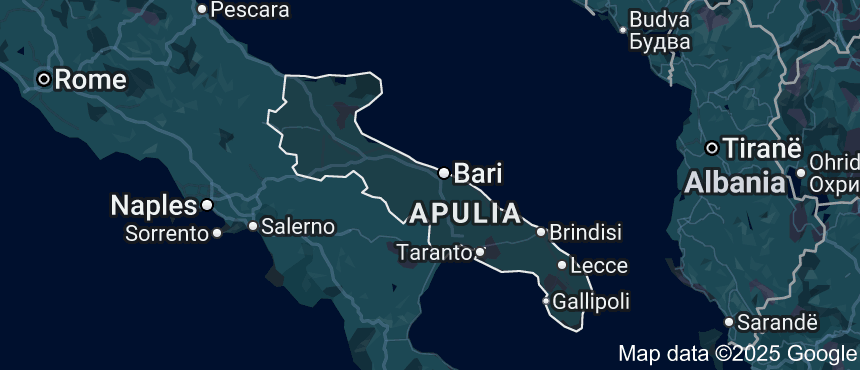
​Today we landing in Bari which is the capitol  of Puglia which is also known as Apulia and even better known as the “heel of “Italy”

Bari became famous in the world of Catholics as the host for the body of St Nicholas (yes that St Nick) who, while Turkish and having never been to Italy had been named their Patron Saint. 
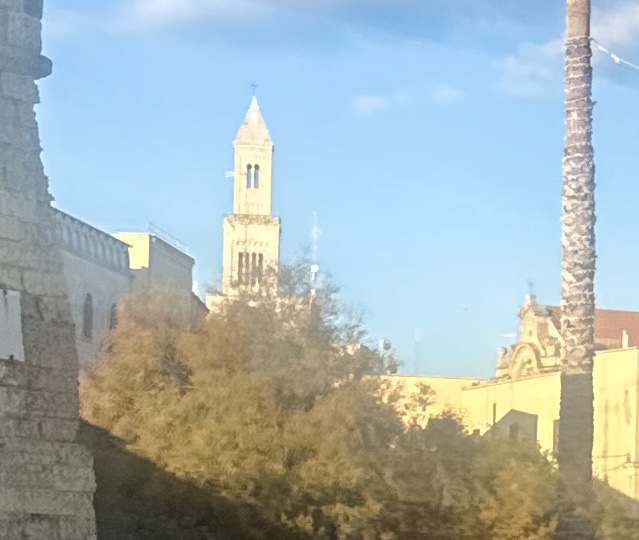
Feel free to check my facts, but apparently back in 1087, while under Norman Rule, 62 sailors were sent to Turkey to steal the body- ostensibly to protect it from the Seljuk Turks advance in that region. 

In any case, it literally put Bari on the map and soon the town began to prosper as pilgrims flocked to the new cathedral. 


Today, however we’re interested in Alberobello. On our drive there we so verdant agricultural land with Olives, grapes, wheat, almonds, cabbage, cherries oh yeah and more olives. 

. 


Puglia is second only to Tuscany in wine production. 


Flat land stands in stark contrast to Croatia and the coast of the eastern Adriatic. 


And you see dry laid stone walls.  EVERYWHERE!  Walls made from the land thats farmed. Dry stone  construction means rain can move through and gaps in walls create microbioms. Dry stone walls received Unesco recognition. 


And between many of these walls you find olive trees. They are everywhere, even in the coat of arms. There are more than 60 million trees. It is said that some of them date back 3000 years. 


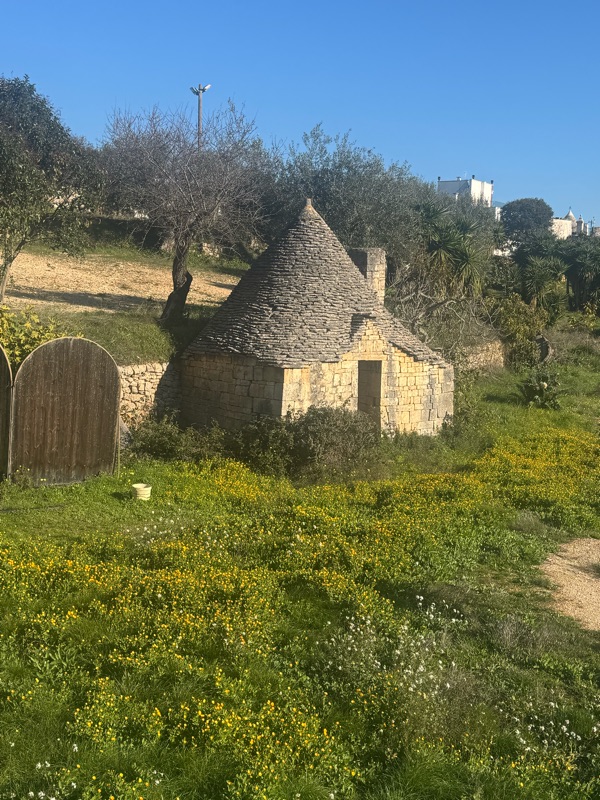
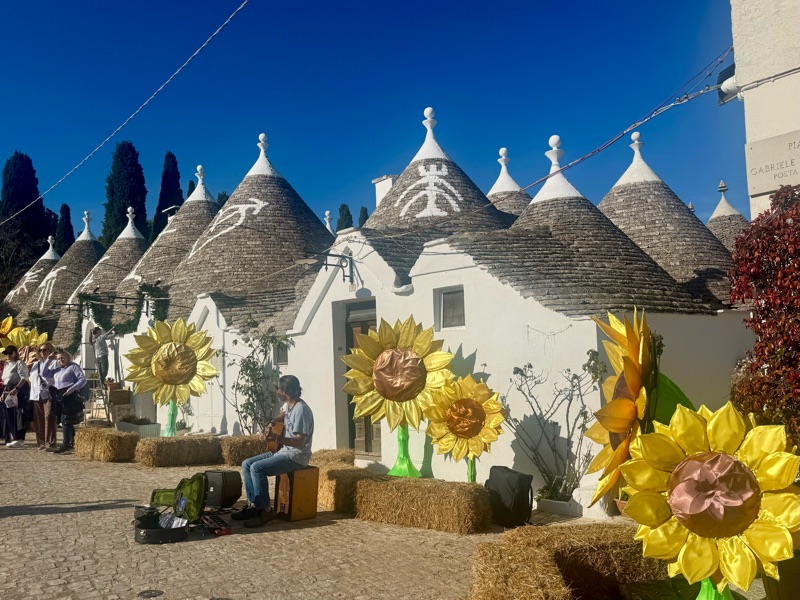
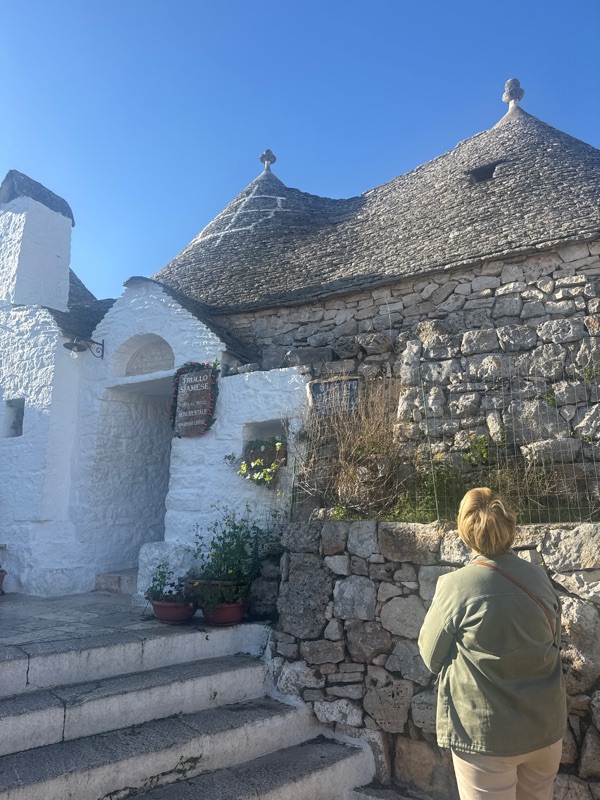
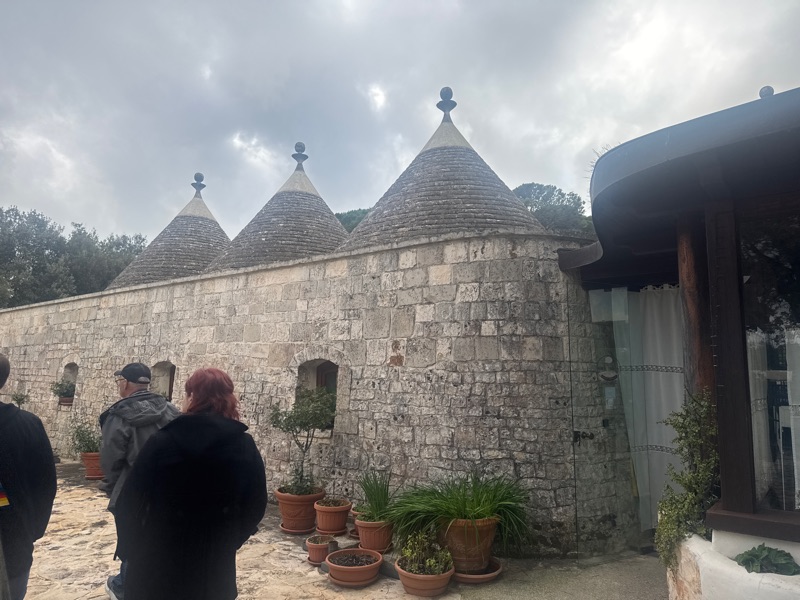
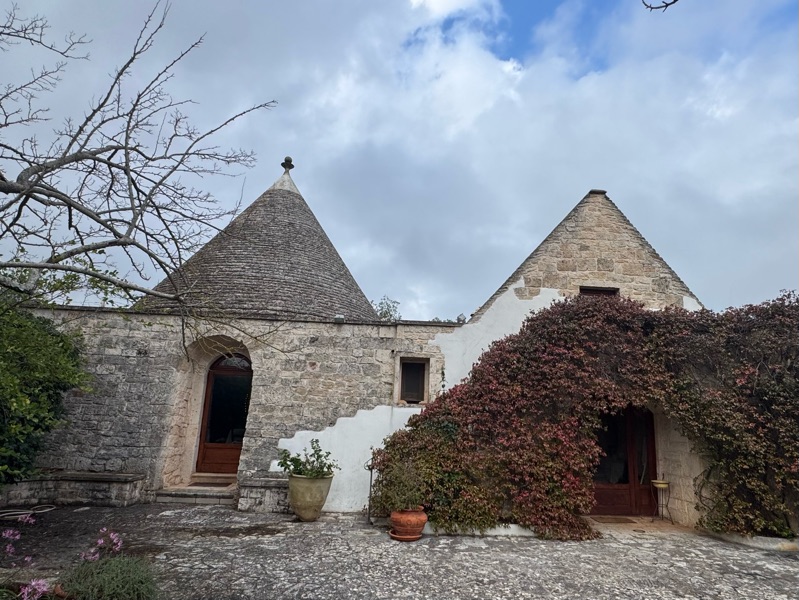
This building dates to ~1600. Back in the  15th century the government asked for a tax on each house built. So order to avoid this they started building house without mortar. And the roofs were laid with stone held in place by one “keystone” at the top. So if inspector came to own you just pulled out the keystone and the roof would collapse. This continued till 1720 or so. Now they use mortar so tourists can safely enter.  


Is a very dry and region, and so system were very very important. Try to collect rainwater distance of chain by digging, were used to build walls and wars were built with large block of line. The most important part is the roof. The roof is made by two different an inner skin inside, which is made by the same technique of the wall with large blocks of limestone and now there’s skin where the flags are slightly tilted outwardly and the structure is waterproof water.

You can see above  how the water was directed for easier collection. The guide is pointing to the runoff stone. 

Apulia actually means “no water” so its management was of great concern. 

You may notice that there are some different shaped keystones. The design indicated the builder. 


With the narrow winding streets and the small buildings everything is close and the smells of food in the modern town were everywhere. One can only guess what it might have been like when there were other “more earthy” scents mixed in. 


Two roofs connected for two brothers in love with some woman. I’m not quite sure how that story worked out. 

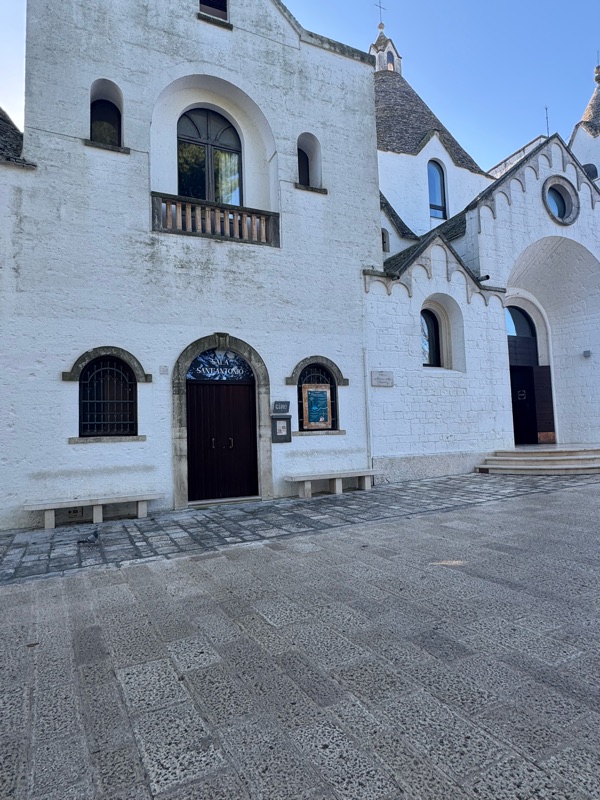
It is sometimes  also called the “white City”. Apparently at the time of the plague it became to commonplace to whitewash the buildings. Apparently the quicklime in the mixture had certain antibacterial properties - well that certainly wasn’t part of their awareness - but it became a common practice. 


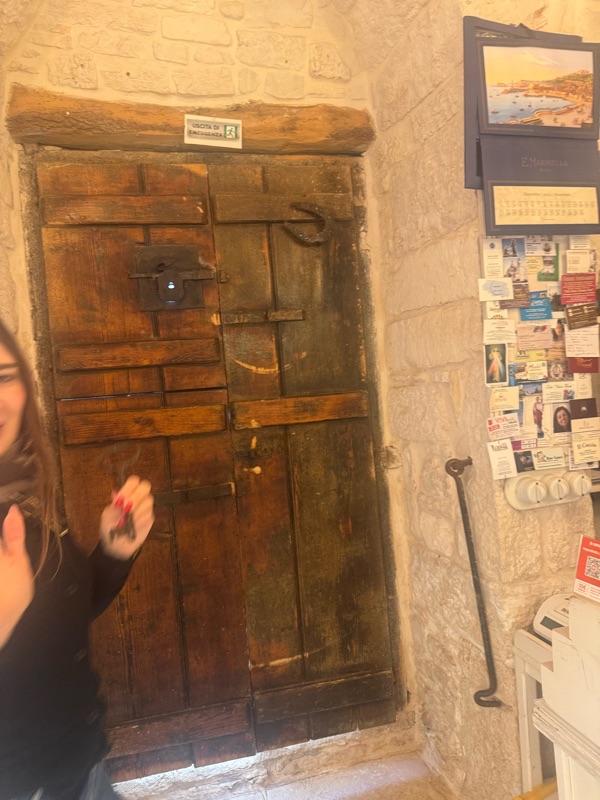
The houses themselves were small, rarely with room for more than a family of 7.  There might be a loft for the parents and then in the one big room a corner of the kids, one corner for the kitchen. There was one door and often the only window as in that door - you can see it in the upper left quadrant of the door above. 


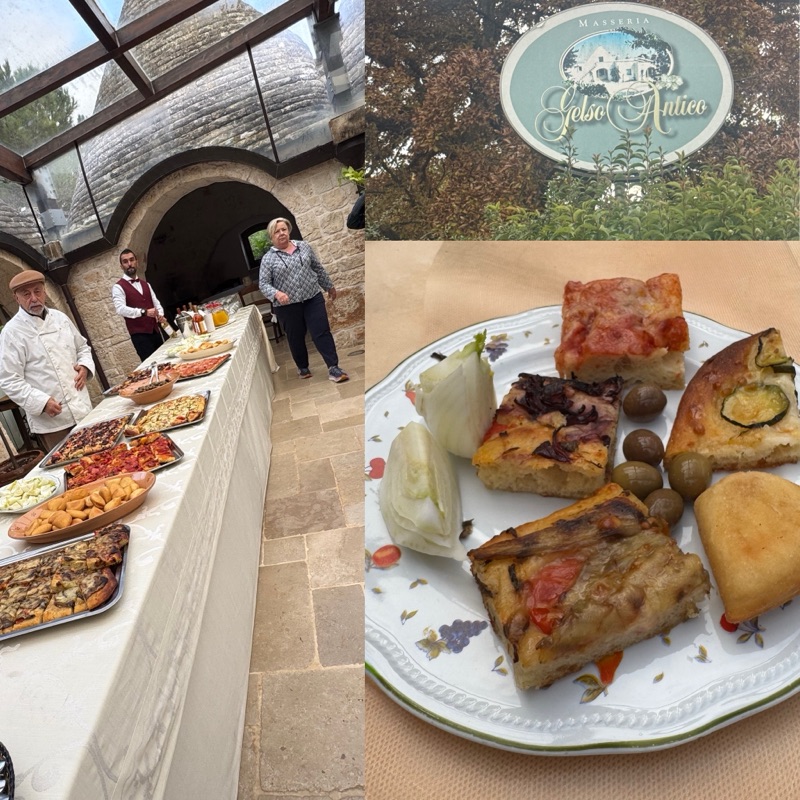
Later we drove to a farmhouse where we were treated to an assortment of homegrown foods 


There were 5 types of focaccia featuring local vegetable, olives of course and a couple big chunks of fennel. Plus of course some local wine. 


And I never got to tell you about the railroad cherries and way grandma told her granddaughter about adultery…..


I didn’t do the tour in Bari or the galley tour. I’ve been thinking about my incredible friend Elliot. He’s been a role model for many many years and we will miss him. But I won’t miss the  lousy Chinese food you always made me eat  Elliot!.